(http://static.guim.co.uk/sys-images/Guardian/Pix/pictures/2008/05/09/foetusnew460.jpg)
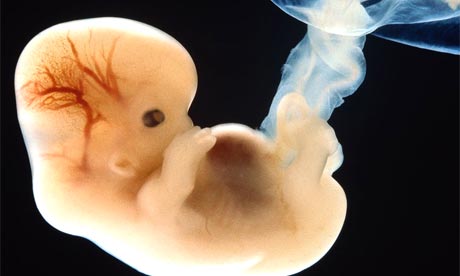
Lub-dub…lub-dub. Twenty-two days after fertilization, a human heart is beating (National Right to Life). Life presents itself as a particularly confusing topic nowadays. Many activists argue that human life begins when the heart starts beating. Despite these activists’ claims, life’s beginning is very debatable. The European Court of Justice (ECJ) attempted to differentiate between living and nonliving when they consented to the request of the German Supreme Court to clarify the “ambiguous wording” of a European Union ban of patents on procedures that use “human embryos”. The ECJ ruled that a “human embryo” comprises of an ovum that has been activated to divide by fertilization or other artificial means and that “research involving human embryonic stem-cell lines is immoral, because such cell lines are originally derived from fertilized eggs” (Nature). The ECJ was acting accordingly when it defined the “human embryo” because the “human embryo” is a living organism and is not necessary for stem-cell research.
A formal ruling needed to be made by the ECJ to define life because the biological definition of life is very debatable. Biologists define life as anything that contains these seven properties: order, reproduction, growth and development, energy processing, response to the environment, regulation, and evolutionary adaptation (Campbell). Despite this thorough definition, life is a puzzling concept to wrap your head around. This is evident in the debate as to whether or not fire is alive. It can be argued that fire has each of the properties of life except for order and evolutionary adaptation. Despite these two setbacks, it is still possible to argue if fire is alive. One just needs to stretch the definitions of order and evolutionary adaptation to argue that fire is a living thing. If it is possible to argue that fire is alive, it is certainly possible to argue that any egg that has been fertilized is alive. The arguable character of the biological definition of life prompted the ECJ to make its ruling. Before the ruling made by the ECJ, the “human embryo” (the general standard for human life) had not been clearly defined. Thus it was not clear if harvesting stem-cells from cultures of cells was murder or not. Opponents to the ruling made by the ECJ will argue that “human embryos” are not alive because they do not have beating hearts and using stem-cells from “human embryos” is not immoral.
Despite arguments made by proponents of stem-cell research, the “human embryo” has every property of life. These proponents may argue that “human embryos” are not able to reproduce when they do, in fact, have the potential to reproduce. Since “human embryos” possess every biological characteristic of life, harvesting stem-cells from “human embryos” is the same as aborting a fetus. Both of these horrible processes involve taking a life for personal benefit. Thus, the ECJ should be celebrated for deeming procedures that utilize stem-cells harvested from “human embryos” as immoral. Courts around the world should follow the ECJ’s initiative and deem these horrible procedures as immoral. Supporters of stem-cell research may argue that the act of outlawing procedures that utilize the stem-cells of “human embryos” is immoral because it ignores the well-being of patients in need of procedures that utilize stem-cells.
Outlawing procedures that use stem-cells from “human embryos” is not immoral because it does not deny patients their needed stem-cell treatment. Procedures that take advantage of stem-cells do not require stem-cells harvested from “human embryos”. Instead, stem-cells can be harvested from a newborn’s umbilical cord. While it is easier for patients to receive stem-cells from “embryos”, stem cells can be harvested from each individual’s umbilical cord after birth. Obtaining stem-cells from umbilical cords allows doctors to perform important procedures that use stem-cells without the risk of rejection and without aborting innocent “human embryos”.
The European Court of Justice essentially made a ruling because of a request made by the German Supreme Court. The ECJ did not act out of line and abuse its power when it defined the human embryo. Instead the ECJ confirmed that murder is in fact illegal. While the ECJ is not an authority on stem-cell research they were correct in their ruling because they did not outlaw all procedures that use stem-cells.
Citations:
"Error of Justice." Nature 480.7377 (2011): n. pag. Web. 9 Feb. 2012. <http://www.nature.com/nature/journal/v480/n7377/full/480291b.html>.
Campbell, N. et al. (2009). Biology Concepts & Connections. Seventh Edition. Pearson Education, Inc.
National Right to Life. N.p., n.d. Web. 26 Feb. 2012. <http://www.nrlc.org/abortion/index.html>.

No comments:
Post a Comment