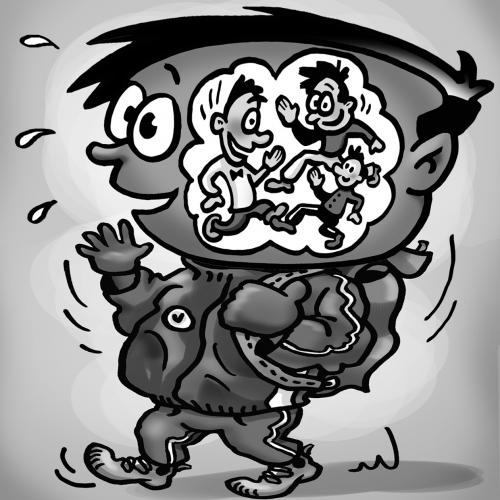
In society, the media we are exposed to causes us to form opinions of many controversial topics, people, and places. For example, there is often a very general portrayal of schizophrenics in television shows and movies. Movies and TV shows will most likely follow the storyline of a schizophrenic who has created a heinous crime and news broadcasts often follow high profile crimes committed by them as well. Thus, many people have a skewed conception of what schizophrenia is and what characteristics qualify a person to be a schizophrenic. The author of “Combating Schizophrenia” argues that society must gain a better understanding of the disease and realize that it is a series of conditions rather than a single condition and only then begin to treat the disease. The article, “Splitting Schizophrenia,” agrees that the disease is a collection of symptoms and delves deeper into the cause and root of Schizophrenia and specific examples of what causes the disease, such as genetics and environmental factors, while “Combating Schizophrenia” focuses on more effective and recent ways to treat the disease, using researchers newfound understanding of Schizophrenia.
Schizophrenia is characterized by various symptoms ranging from hallucinations to violence; in order to treat the disease, researchers must understand that it has a broad effect upon the brain of sufferers.
Suffering from schizophrenia is not something that is avoidable for people who have the disease. Once psychotic thoughts enter their brain, they are lost in another personality and will never find their true selves again. Many sufferers spend hours and hours in therapy sessions in order to learn how to control their thoughts and operate in a normal and orderly fashion. “Drugs that treat the delusional symptoms have been around for decades, and have helped many sufferers enormously. But these drugs have not advanced in effectiveness, and several manufacturers have now backed out of this arena.” [“Combatting Schizophrenia”] This article clearly expresses that what was once believed to treat or alleviate the symptoms of schizophrenia can no longer be effective, being that they are not always “long-term.” The author of “Combating Schizophrenia” feels that researchers should first “distinguish the early phases of this condition, using all the means of biological, [behavioral] and cognitive analyses” to aid in the treatment of schizophrenia.
The author does not totally dismiss the causes that are presented by “Splitting Schizophrenia.” Both articles agree that “genetics and environmental factors” play a role in the progression of schizophrenia. However, “Combating Schizophrenia” gives more insight on what should be done to effectively “combat” the disease, using the recent knowledge that has been discovered.
Works Cited
"Combating Schizophrenia." Nature468.7321 (2010): 133. Nature Publishing Group. Web. 3 Feb. 2012.
Lander, Eric S.. "Splitting schizophrenia."Nature 336.6195 (1988): 105-106.Nature: International weekly Journal of Science. Web. 3 Feb. 2012.

No comments:
Post a Comment